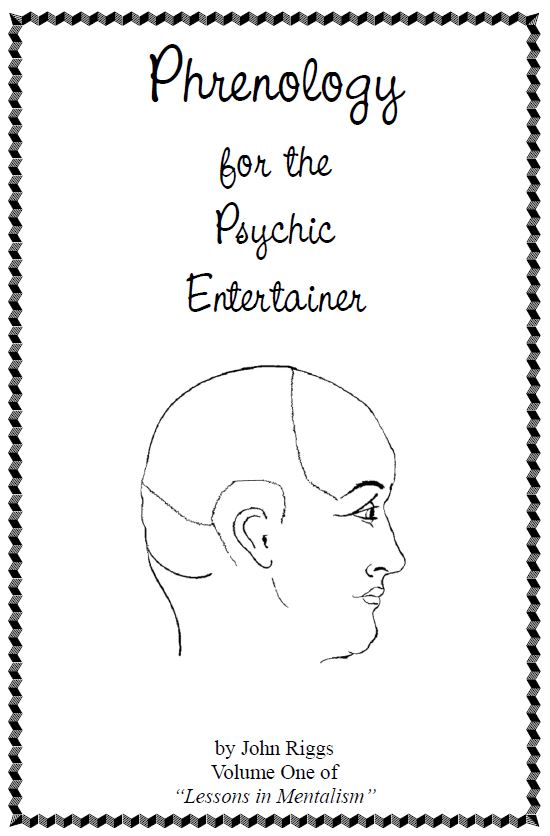
Summary of Phrenology for the Psychic Entertainer by John Riggs
Phrenology for the Psychic Entertainer is a guide by John Riggs, framed as Volume One of “Lessons in Mentalism,” designed to teach psychic entertainers a system for delivering phrenology-based readings and scalp massages. Below is a concise overview of its core content:
Introduction & Purpose
Phrenology, described as an “almost lost art,” is presented as a tool for psychic entertainment, leveraging the public’s enduring interest in “body reading” techniques (e.g., palmistry, face reading). Riggs emphasizes its utility for generating personalized readings, with 42 “organs” (skull areas) linked to personality traits, and includes a phrenology chart and mnemonic system to simplify learning.
Historical Context
Phrenology’s origins trace to German doctor Franz Joseph Gall (1758–1828), who proposed that skull bumps correspond to underlying brain development. Popularized in the 19th century across Europe and America, it was later overshadowed by Spiritualism. Riggs suggests a potential resurgence, framing it as an “arcane practice” ripe for revival.
Core Concepts: Organs & The System
- The “Organs”: The skull is divided into three main regions—front (intellectual), middle (emotional), and back (instinctive)—subdivided into 42 “organs” (e.g., “Individuality,” “Laughter,” “Amativeness”). Each organ is linked to a personality trait, determined by palpating skull bumps.
- Mnemonic System: To simplify memorizing the 42 organs, Riggs uses an alphanumeric mnemonic method. Numbers 1–42 are paired with substitute letters (e.g., 1=T/D, 2=N, 3=M) to form “mnemonic words” (e.g., 1=”Tow,” 2=”Noah”). Each word corresponds to an organ, its attribute, and a “cold reading line” (e.g., 1=”Tow” = Individuality = “Original, independent”).
Practical Application: Readings & Attributes
The guide provides a “Phrenology Form”—a checklist of the 42 organs (with traits like “Love of travel,” “Sense of humor,” “Organizational skill”)—to structure readings. Riggs advises against rote delivery, urging adjustments for client age, appearance, and context. Each organ’s attribute is paired with vivid “cold reading lines” (e.g., Locality: “Love to travel, sensitive to environment”) and mnemonic images (e.g., “Shoe” for Locality, imagining a giant shoe as a travel vehicle).
Appendices & Additional Context
The appendix includes:
- Historical Overview: Details phrenology’s evolution, key figures (e.g., Gall, Spurzheim, Fowler brothers), and its decline due to “con-men” and scientific skepticism.
- Modern Advocacy: Defends phrenology as a “true science” for self-knowledge, education, and character analysis, addressing criticisms and diagnostic errors (e.g., skull deformation,忽视 faculty interactions).
- References: Lists works by modern proponents (e.g., Paul Bouts’ Psychognomie) and sources for phrenology tools (e.g., porcelain heads).
Conclusion
Riggs positions this book as an entry into mentalism, offering a practical, mnemonic-driven method to master phrenology readings. It teases future volumes on mentalism basics like billet work and pocket writing.
In essence, the text blends historical context, mnemonic learning, and performance tips to equip entertainers with a structured, engaging phrenology-based routine.
Comments0