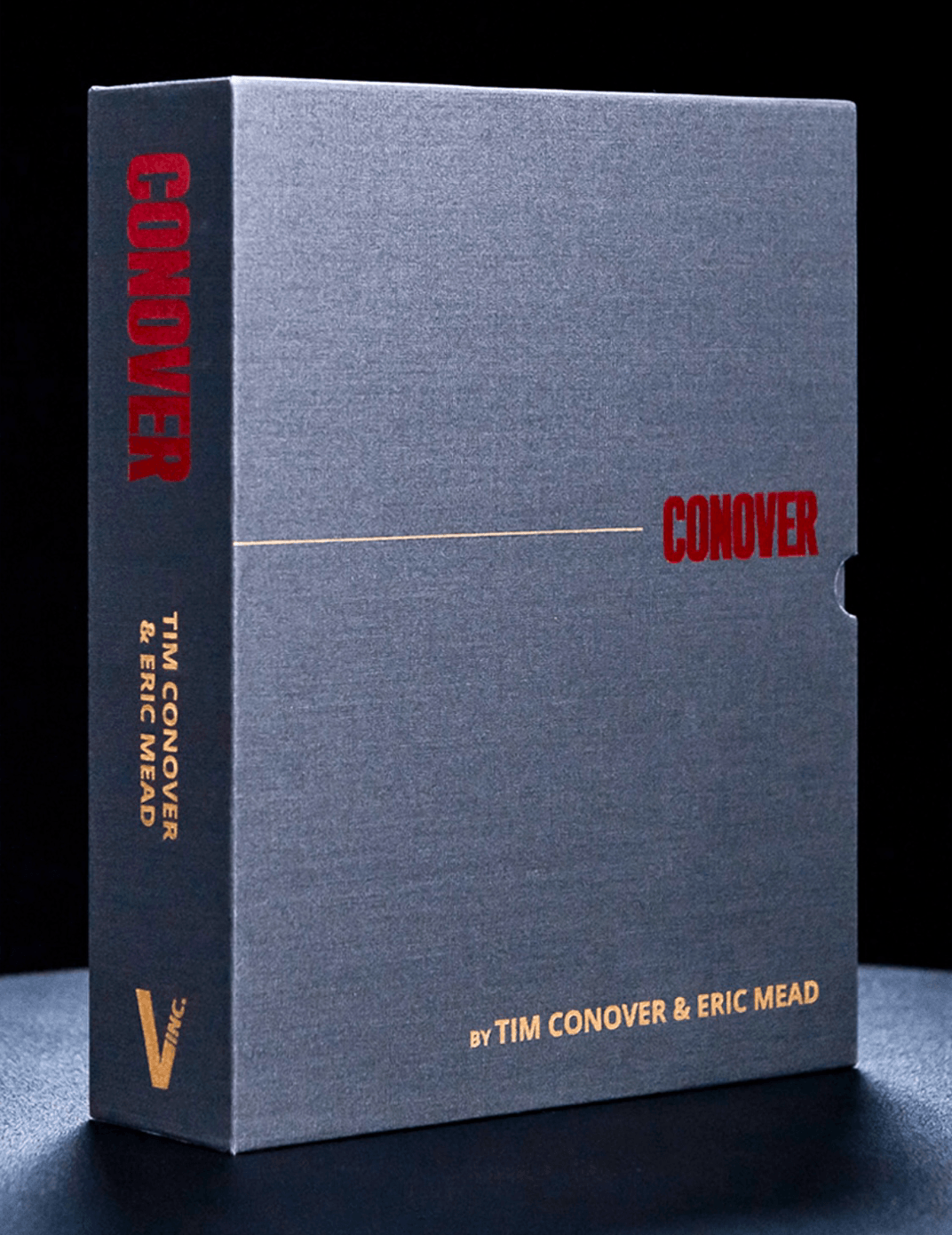
Volume 1 | The Magic of Tim Conover
The first 45 pages of the book is all background information on Tim. It has two Acknowledgements–one by Eric Mead and one by Shari Conover Rosenberg (Tim’s sister), two Forewords–one by Shari Conover Rosenberg and one by David Williamson, an Author’s Preface, and a section titled True Believer that gives us some information about the type of person Tim was on and off the stage.
Honestly, it feels like a lot, especially considering there are two more books, but as someone who had literally no knowledge of Tim Conover before this, it was great insight into the type of person he was and how he approached his material.
Splitting the Rose – The performer twists some paper into the shape of a rose. In a flash of fire, it becomes a real rose. The performer hands the rose to one of the ladies sitting at his table. Noticing another lady present, the performer takes the rose back and splits it into two roses so that each lady can have one.
This is Tim’s solution to “The Creation of Life” effect that doesn’t require any living creatures. Everything is well motivated, the moves are simple, and it makes for a great piece that acts as sort of a magical introduction before the real magic begins. It’s also super practical.
Goshman Shakers Simplified – Coins repeatedly disappear and reappear under salt and pepper shakers.
This is essentially Goshman’s original routine. Tim has eliminated a couple of awkward moves, but it is about 95% Goshman’s. It’s a difficult piece that requires an understanding of misdirection and many coin sleights. I can see why Tim loved it, but it is something I won’t be putting the work into learning. It’s a fine routine, but also kind of that classic meaningless coin magic where coins travel, appear, disappear, and change for no reason other than because it’s magical.
The Bending Coins – Six half dollars bend in an increasingly impossible way.
For me, this is the best routine in the entire three book series. I absolutely adore everything about this, and I’ve already begun my hunt for the necessary items. Nothing is gaffed, but you have to obtain some half dollars with some matching dates. It is really difficult for me not to write things that sound hyperbolic when I’m excited about it, but genuinely, I think this routine is perfect. The construction is genius, and the subtle layering of methods makes it virtually impossible to backtrack; it would have fooled me badly if I could have seen it. It literally only uses two moves that anyone with even basic knowledge of coin magic can do. I will be using this.
The Mouse – A cute interlude where a mouse appears and disappears just as quickly.
This is described as a magical sight gag. It is just a funny moment to bring some levity to the performance, but it is also fooling because both hands are shown empty throughout the bit. This would be very easy to make up and put into practice. I’d never use it, but it’s cute.
The Money (901) – A stack of six $1 bills changes into $5 bills, then $10 bills, then $20 bills, and finally $100 bills.
This is the first trick Tim created when he was around sixteen. It cost $901 to make up the trick (hence the title). Some clever things are happening here, but it’s a lot. It requires a switch of the packets midway through the routine, which is a dealbreaker for me. It’s also quite a bit of work to build the necessary gimmicks. After the routine is taught, we find out that there were some notes left by Tim on an updated version. Eric tried to reconstruct it based on the notes and the bills that Tim had left, and he teaches that as well. It seems this new version was created to be able to be performed with the new style of bills. The original version, as written, would only work with the old style bills, which are already out of fashion.
Fred Kaps Chinese Coin Trick Simplified – A small Chinese coin grows larger. The small and larger Chinese coins switch places a couple of times, and then an even larger Chinese coin appears. Then an EVEN LARGER Chinese coin appears. Finally, a large brass statue also appears to end the routine.
Tim has taken the complex Fred Kaps routine and turned it into something that could actually be performed for audiences. It’s a weird little routine, but I’m sure the various appearances would surprise audiences. You do have to perform it seated at a table. I won’t be learning it, but if you wanted to, I think you’d have a hard time finding appropriately sized coins.
Shot Glass Apparition – A handkerchief is removed from a jacket pocket and covers the performer’s clearly empty hand. The audience can pat the performer’s hand through the handkerchief to feel there’s nothing there. In an instant, a shot glass full of liquid appears on the performer’s palm.
This is another really great and practical piece. You can do this strolling or table hopping very easily. It’s so easy that it almost feels silly, but it’s really disarming. Once the normal handkerchief is brought into play, you have everything you need. There are no body loads necessary. It’s also very easy to acquire the items you need. I don’t know if I’ll be using it, but I can see this being one of the most used items from the series for its sheer practicality.
Purse Frame and Coins – Six coins are removed from a purse frame with no bag. The coins jump hand to hand several times and then vanish back into the bagless purse at the end of the routine.
This was one of the only “pure” coin tricks Tim performed professionally before he introduced the Goshman Shakers routine into his repertoire. It didn’t tickle my fancy when I read it. Again, it’s coins kind of vanishing and reappearing with no real purpose, but it’s solid in its construction. I won’t be performing it; as soon as a magician brings out a coin purse frame, I cringe, but if you’re a coin guy looking for a routine, this may be right for you.
Lenses – The performer reaches up to his eye and removes a huge “contact lens” from each eye.
This is another magical sight gag. It is a quick interlude to introduce some levity. It’s not my style, but it’s cute and easy to do.
Salt Pour – Salt is poured into the performer’s hand. It vanishes. He reaches into the air with the other hand, and salt begins to pour out of that hand. It continues endlessly, eventually pouring out of both hands. The salt finally stops pouring out, and the hands are immediately opened and shown to be completely empty.
This is the best version of the salt pour I’ve seen. The gimmick is eliminated early in the routine so that at the end, even though salt is continuing to pour from both hands, there is no gimmick in play. It’s a very practical routine and method. If I were going to add a salt pour into my performance, this would be the one I’d use.
Goldfinger – A black coin purse is introduced. Six silver dollars are removed from it and examined. Five of the coins go back into the purse, and the last coin changes into gold. The purse is opened, and the gold coin is touched to the other coins inside, where they all change to gold. Finally, the purse is given a rub, and it also turns to gold.
I don’t like this routine. I just think it’s cheesy and silly. All of the work is done in a switch of the purse, which seems too obvious to me. There’s also a couple of alternative methods discussed, but this was the one routine from all the books that I couldn’t care less about.
Ouroboros – The Unequal Ropes – A classic three rope routine. Three unequal ropes become the same length, two of the ropes join into one rope, the ends go into the pocket and jump back out, the third rope is absorbed into the long rope, the ends of that rope multiply until there are once again three ropes of three different lengths.
I used to have Richard Sanders’s Fiber Optics routine in my show, so I know rope magic can play very well. This routine is well constructed and flows nicely. It won’t replace my Fiber Optics routine, mainly because I enjoy the more visual nature of that one, but this is a great rope routine you can add to your set.
Sockless Coins – Four silver coins and a copper coin are used. The performer’s hands are clearly empty except for these coins. The silver coins are held in the spectator’s hand, and the performer plucks one of the coins from their hand. This is repeated a second time. The third time it’s done with the performer’s hand. For the last coin, the spectator holds the silver coin while the performer holds the copper coin. He plucks the silver coin from their hand and then makes the copper coin vanish into their hand.
This is another one of my favorite routines from the books. I’m not a coin guy, but I really like the structure and routining of this. It’s easy to do, and the moves happen at unexpected times. This may become the only coin trick I do; I like it that much. I think what I like the most is how simple the concept is to follow. Coins aren’t bouncing around all over the place. It’s a very clear plot of a coin being pulled from a hand repeated four times. The last one, while technically a transposition, still falls in line with the plot thanks to the change in timing, and the introduction of the copper coin makes sense within the logic of the trick. I’ll be performing this one for sure.
Cups and Balls – Tim’s direct and “hands off” approach to cups and balls ending with the appearance of three cue balls and an eight ball.
Tim’s version relies heavily on Dai Vernon’s routine, but Tim has cut out a lot of the fluff and just left the strongest parts of the routine. The loads of the solid billiard balls add an element of impossibility because they would clearly make noise against the metal cups. The cups are slightly altered to dampen the sound. Again, I won’t be learning it, but if I were to do a cups and balls, this is the one I would do. I like how efficient and “hands free” it all feels.
Toolbox – Tim’s thoughts on card techniques
It’s kind of crazy that there isn’t a single card routine taught in the book. To me, that makes it clear that Tim only used classic card magic. This section doesn’t teach any routines, but it teaches his very small touch on Tommy Wonder’s Deck Switch, his handling of the Tamariz False Shuffle, his use of preshow with cards, a card control, and his take on a card to can.
Comments0