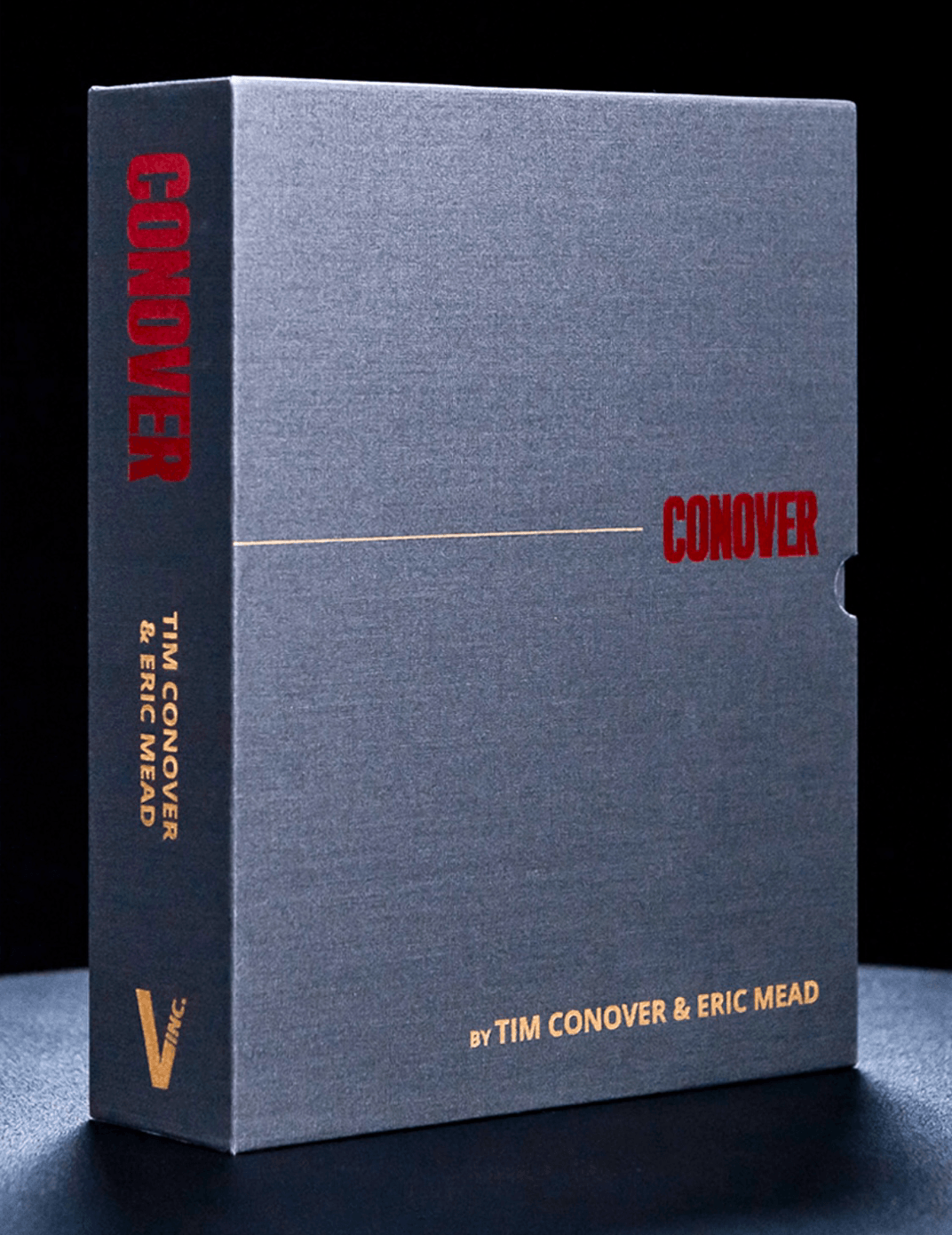
Volume 2 | The Mentalism of Tim Conover
This is the volume I was most excited about. I bought the set solely for his work on mentalism. This book begins with a Foreword by Tim’s brother–Michael Conover, a Foreword by Michael Weber, and a section titled The Illusion of Reading Minds that discusses how Tim got into mentalism and how he used it as his bread and butter for trade shows and corporate work.
The Old Coin Opener – Tim’s take on Koran’s Medallion.
The unique thing here is that it uses a very large coin that is removed from an envelope that is in the performer’s wallet, and it doesn’t use a sticker on the coin. It’s not too big a departure from the original, but the small touches do add to the impossibility. I won’t be using it, but it’s solid.
Three Bent Spoons – Borrowing three spoons from the tables, the performer bends and twists one, bends another, and breaks the final one.
The unique thing here is how he gets the prepared spoons into play. You can really only do this if you’re performing somewhere where the guests are eating with nice silverware. I don’t really ever perform in those environments, so this one is out for me, but I know a lot of corporate guys are doing a show after/during dinner. If you want to add spoon bending into your set, this is a fine way to start. The benefit here is that you are using two prepared spoons, so even if the spoons are really thick metal, you can make sure you get a nice bend in them since you prepare them before the show.
The Newspaper Prediction – A newspaper is torn in half, and an audience member decides which half to eliminate. This continues until there are just a couple of small pieces left. An audience member decides on the last piece they want, and the performer reads off a prediction that predicts the exact word they will choose from their piece.
This is a bold prediction effect, but the choreography makes it effective. There are a lot of benefits to this. This word isn’t forced, the selection process isn’t forced, and the word is different every time. The downside is that it relies on a prediction that is typed on an index card, and you don’t have any flexibility with how the word is revealed, since that is where all of the method lies. It will take some guts to try this for the first time, and it only really works on stage, but it does come together nicely.
Duplication of Drawings – The performer hands out three folios to spectators. Each makes a drawing, closes the folio, and all three folios are mixed before being handed back to the performer. The performer shows the audience all of the drawings while he looks away. He then is able to hand the folios back to the appropriate audience members and duplicate each drawing, even though he supposedly never saw them.
I don’t know how I feel about this. It’s clever, and it’s a real method that works, but it also feels like one of those things that is either too obvious or too impractical for it to actually be any good. Clearly, Tim has used it and gotten a lot of mileage out of it, but I feel like the only explanation the spectators would have that “he somehow saw the drawings” is the right one. And sure, that’s true for every drawing duplication, but there’s a moment when you have to stand behind your table to show the audience the drawings, and that feels like it’s too contrived to actually be fooling. I’ve got way better drawing duplications in my arsenal that I’ll stick with.
Three Book Test – Three spectators each think of words from three books. The performer can tell each person the word they are thinking of. Then, as a finale, a book is handed to someone further in the audience. They turn to a random page and begin reading in their mind. The performer directs them to a certain word (for instance, the fourth word on the fifth line) and can reveal that word.
This is done using three real books, but you have to gimmick one of them. There are things I like about this, but there are also significant drawbacks compared to many modern day book tests. In this version, the spectator is never allowed to just open their book anywhere they want. For each selection, the performer riffles a book, and the spectator calls stop and opens to the page they stopped at in the book they hold. This feels a little too controlled for my liking. You’ll notice that the video of Tim performing the book test online cuts out how the pages are chosen. It’s also worth noting that they never get to hold the third book. So even though three spectators are thinking of words, only two of them are holding a book. I think Tim was so energetic and exciting in performance that it just worked in his hands, but I think this has the potential to fall really flat. It also requires you to remember a good bit of information at a time, which could be challenging in the heat of performance.
Eyeless Vision – With his eyes duct taped shut, Tim reveals details about items that are placed on a handkerchief in his hand.
I’m not the biggest fan of eyeless vision acts. I just don’t get it. To me, the trick is “watch me see through this blindfold.” Tim has some great subtleties that help it feel less like that, and it ends with a name reveal, which is great, but at its heart, I can’t help but feel that way. This uses the classic method/peek you’d expect.
Crystal Ball Audience Readings – The performer gazes into a crystal ball and describes details about random audience members.
I hate to say it, but this was the biggest disappointment in the books for me. I mean, it shouldn’t have been because it was obvious from the videos that it was all preshow, but I guess some part of me hoped it was something more clever. I have a strict no preshow rule, so I won’t be able to use this. It’s also a little disappointing because the method Tim uses to have a spectator guess a serial number while gazing into the crystal isn’t taught. Apparently, it’s not original to him, and they couldn’t get the blessing to teach the method. They do teach a method that approximates the same effect, but it’s clearly inferior.
The Crystal Ball Tie Peek – A small way to help you remember all of the preshow info.
As it says above, this is a way to peek the preshowed information during the performance in case you forget one of the details, and with as much as you have to remember for the Crystal Ball Audience Reading, I think this would give you some peace of mind.
Linking Finger Rings – Three borrowed finger rings are linked and unlinked.
I really like Tim’s take on this plot. He exploits some clever ruses and verbal subterfuge to make it seem cleaner than it really is. What I really like is that there is a sort of classic gimmick in play, and then Tim uses a natural feature of a pen to aid in the other deceptions. This allows him to get rid of the gimmick earlier than most routines of this style. It is by far my favorite routine in the second volume (funny considering it’s not even really mentalism), and it’s another absolute knockout in terms of perfect construction. This is, for all intents and purposes, the best linking finger rings trick I’ve come across.
The Dream Deck – Three spectators each think of a card from a deck that is spread on the table. The performer reads each person’s mind and reveals each card.
This is the trick that inspired John Kennedy’s “Mind Power Deck.” Tim performed this for John, and John had the idea to do it with misindexed cards so that the entire deck could be spread, and the rest is history. Tim used a different bank of cards and a different pumping sequence. His pumping method is quick and direct to the point, allowing him to zoom through the reveals.
The Conover Center Tear – This center tear allows you to get a real time peek of the center of a business card, despite the card being torn into very small pieces.
This tear can be observed very intensely, and the action will be completely hidden. It does take a little longer to do than some other tears. You actually tear the card seven times during the tear. All the pieces are left with them, and they will find their information genuinely torn and mixed amongst the group. This was Tim’s go to method for preshow and casual mind reading demonstrations. One thing to note is that if you have drier hands, as I do, it can be difficult to get the piece to open properly.
The book ends with a section on the Awards Tim won over the years, a section titled Curtain which discusses Tim’s battle with mental health and his ultimate loss of that battle, and a section titled Friends which contains many photos from his life.
Comments0